
Blogs
Overnight summer camp essentials: Complete packing list for first-time campers
Before the art projects or camp performances, there is one important step every camper goes through: preparing and packing! What your kiddo brings to an overnight summer camp goes a long way in how comfortable and confident they feel throughout the whole session.
At Appel Farm Arts Camp, we know the first camp experience comes with a lot of questions, especially around packing. So we pulled together everything campers need, including must-have essentials and camp counselor tips that make camp life easier from day one. You’ll also find a printable camp packing checklist you can use as you help your kiddo prepare for camp!

Table of contents
- What are the summer camp essentials or must-have items?
- What should kids pack for a creative overnight arts camp?
- What should campers NOT bring to summer camp?
- How can you prepare your child for an overnight summer camp?
- What packing tips do camp counselors recommend for summer camp?
- Printable overnight summer camp packing checklist (PDF)
- Common camp-packing-related questions
- Is Appel Farm Arts Camp a great first summer camp experience?
What are the summer camp essentials or must-have items?
A good summer camp essentials list starts with the basics. You want your child to have what they need for active days, relaxed evenings, bunk life, and creative classes, without sending so much that they can’t find anything once they unpack.
At Appel Farm, campers move through fun, activity-packed days, so we recommend packing for hot and cool weather. Below is a helpful guide for what to bring for our 2-week and 4-week sessions, but feel free to modify the list as needed!
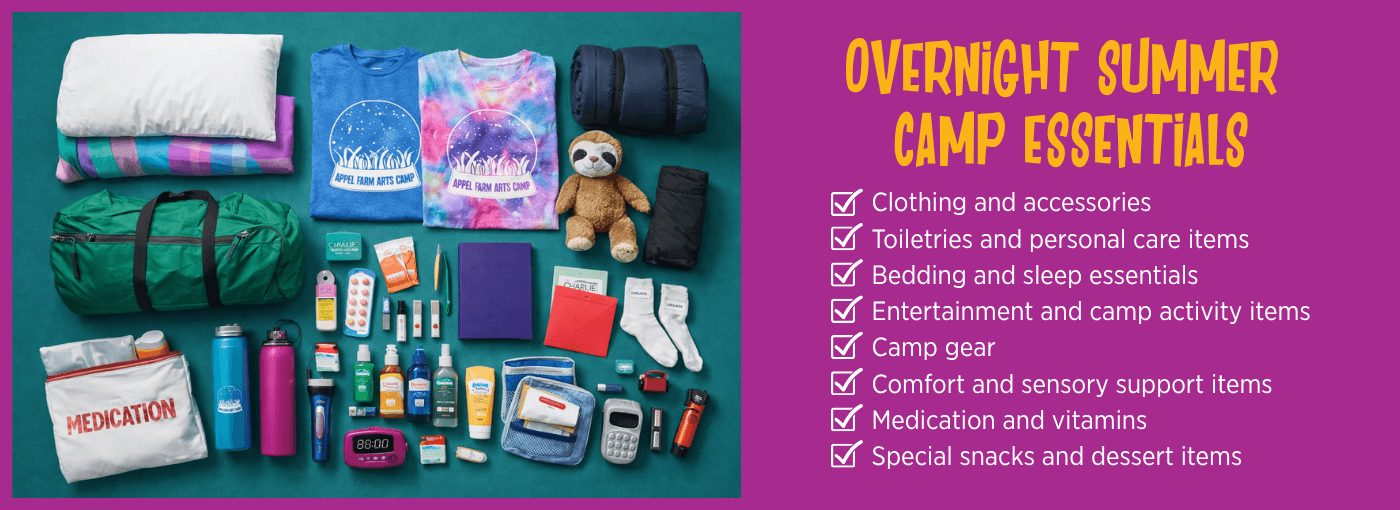
What clothing and accessories should campers bring?
Start with the clothes and accessories your child wears most. Don’t forget to keep them as comfy as possible!
Note on dress code: Appel Farm Arts Camp doesn’t have a dress code. We encourage campers to wear what feels comfortable to them, as long as it provides appropriate coverage (clothing that covers the same parts of the body that underwear covers) and meets safety needs for activities. Clothing should also be free of inappropriate or illegal images or language.
What toiletries and personal care items should campers bring?
A basic toiletry kit for camp should include:
Campers can also buy toiletries from the Canteen, which is the camp store. This is helpful if they run out of toiletries, or if you’d prefer to have your kiddo buy these items at camp rather than pack them.
Since campers are not allowed to keep cash or cards in the bunk, families will set up a Canteen account online before check-in day. We recommend about 20 dollars per week, though you can add more if you would like. At the end of the session, you will review the balance and choose how to handle any remaining funds.
Kiddos can buy the following toiletries at the Canteen:
- Deodorant
- Soap
- Menstrual products
- Toothpaste
- Combs
- Shampoo
- Conditioner
- Textured hair care products, including gels and mousses
What bedding and sleep essentials should campers bring?
Kiddos who sleep well are more likely to wake up ready for the day and enjoy everything camp has to offer. Quality sleep is important for children as it supports attention, mood, memory, overall health, and emotional resilience – all of which are important for a positive camp experience.
So, as you pack, give the sleep setup a little extra thought!
What entertainment and camp activity items should campers bring?
Camp days are full, but those in-between moments matter too. A few familiar and creative items can help campers relax and create more opportunities to bond with other campers who share their interests. In fact, research shows that unstructured time and shared activities help kids feel connected, build social confidence, and support mental health.
What camp gear should campers bring?
These are some of the items that make camp life more convenient:
What comfort and sensory support items should campers bring?
Think about a few optional items that make camp feel more comfortable for your kiddo as they spend days away from home. These are especially helpful for first-time campers! Being in a new environment can bring up homesickness, which is a normal part of the experience for many children. Familiar objects, like a favorite blanket or stuffed animal, can help soothe children’s separation anxiety or homesickness and help them adjust to new settings.
What medication should campers bring?
At Appel Farm, all medications must be kept in the Health Center and will only be administered by the Health & Wellness team members or the Camp Physician. Medications must stay in their original containers, as camp cannot accept anything stored in zip bags or alternate packaging.
Inhalers, EpiPens, and/or other life-sustaining medicines may be kept in the bunk with the Health Center staff’s permission.
“Medications” can include:
Campers who take daily medications will visit the Health Center at scheduled times after meals or before bed, and any special timing should be noted on your Health Form and discussed at check-in.
Can allergic campers bring special snacks and dessert items?
Appel Farm offers gluten-free, dairy-free, vegetarian, and vegan options with every meal, and we can accommodate campers with mild nut allergies.
If your camper has allergies or specific dietary needs, inform a Camp Director and fill out your child’s dietary allergies or needs on your Camper’s Health Form.
Campers with gluten allergies are welcome to bring their own snacks or dessert items to supplement what is provided. These items should be clearly labeled with your camper’s name and turned in to the Health Center staff on check-in day, where they will be safely stored.
But generally, outside food and drinks (aside from water) are not allowed in camp – read more about our prohibited food and drinks here.
What should kids pack for a creative overnight arts camp?
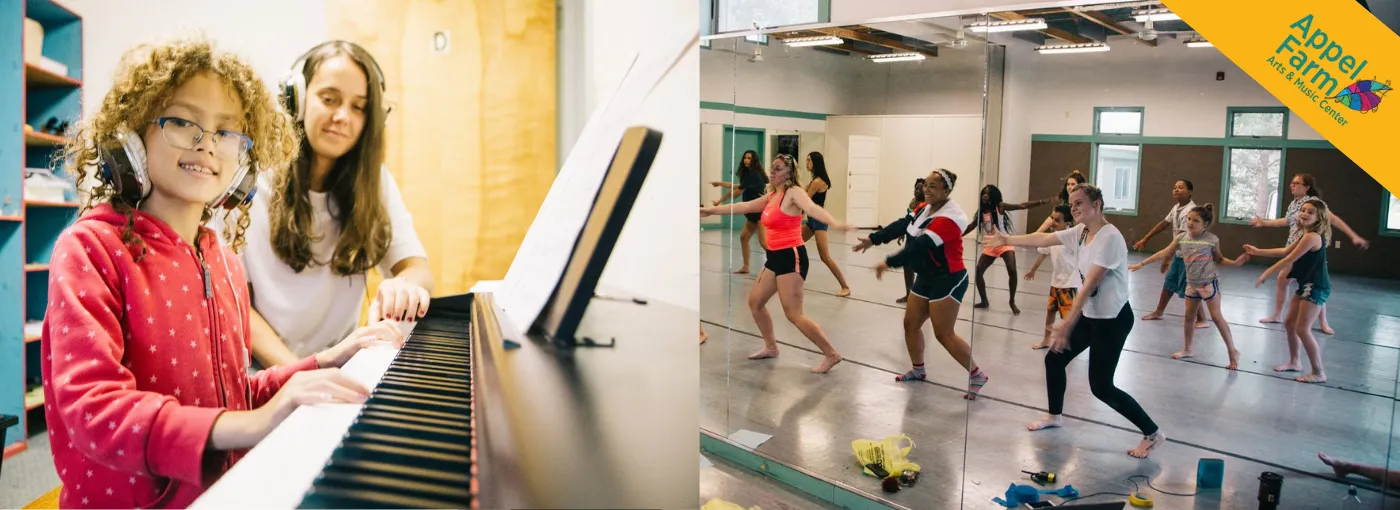
At Appel Farm, days are active and creative. Campers might move from music to dance, and then from visual arts to theater, all in one day.
We provide all required class supplies, including instruments, dance shoes, cameras, and more. The items below are optional and meant for campers who prefer to bring their own (be sure to label all personal belongings clearly!).
What should campers bring to an overnight music camp?
Music campers can bring the instrument they plan to study, except keyboards and drum sets. If bringing an instrument is not possible, we have many available! Just be sure to contact the Camp Directors ahead of time.
Some examples of optional items campers might want to bring:
What should campers bring to an overnight dance camp?
For dance, the focus is on being able to move freely and confidently in class.
Some optional items to pack include:
What should campers bring to an overnight visual arts camp?
Visual arts campers benefit from having a few personal tools they enjoy using. Campers can also bring optional art supplies they enjoy using, such as:
What should campers bring to an overnight media arts camp?
For media arts, campers may bring the following optional tools to help them work on their projects comfortably:
What should campers bring to an overnight photography camp?
Cameras are provided by camp, but photography campers are welcome to bring their own if they have one they enjoy using, along with optional items like:
What should campers bring to an overnight technical theater camp?
Technical theater campers should pack with backstage work in mind. Some examples of optional items they can bring include:
What should campers NOT bring to summer camp?
Keeping certain items out of camp helps create a safe, focused, and community-centered environment where campers can fully unplug and enjoy the experience. Appel Farm keeps a few clear guidelines around what stays home, so campers can feel safe and stay focused on the fun parts of camp.
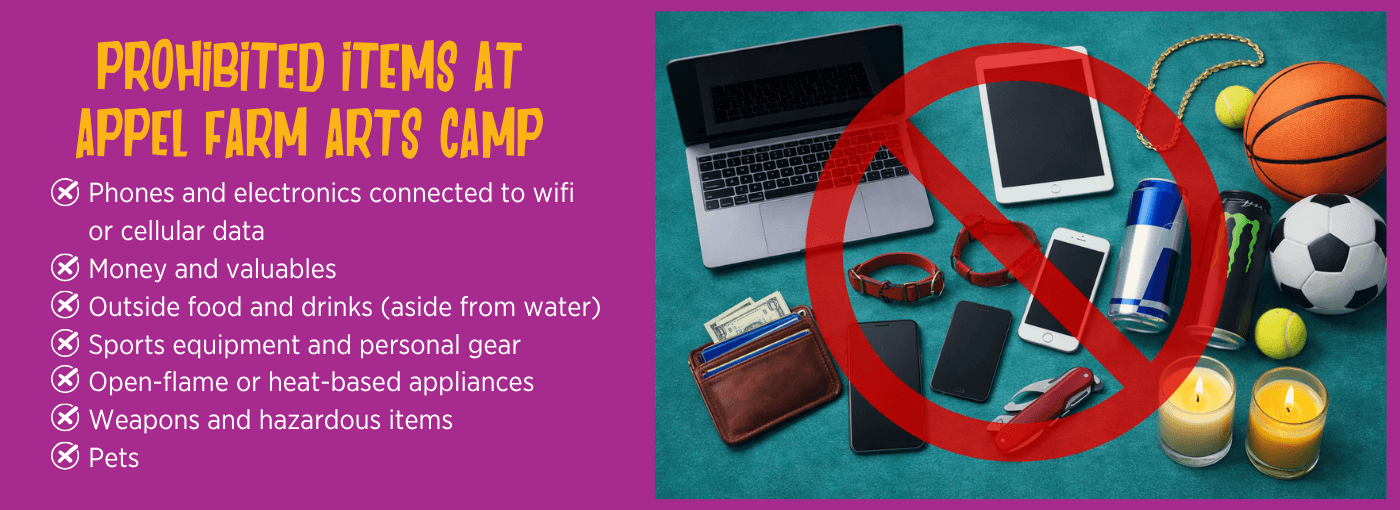
Can campers bring electronics and technology to camp?
While technology can support learning in some settings, research shows that excessive screen time in children and teens is linked to challenges with attention, learning, and academic performance, as well as reduced face-to-face interaction.
Camp is a screen-free environment, so devices with active cellular or data connections are not allowed. Time away from screens gives campers the chance to fully engage in creative activities and community life, support better sleep, improve mood, and build stronger social skills.
Prohibited devices include:
The only exception is for our counselor-in-training (CIT) program participants, who may bring a laptop for occasional supervised use.
That said, families can still stay connected with their kids without devices. Letters and emails are a big highlight, with messages from families shared daily during rest time and plenty of chances for campers to write back. You can also follow along through camp photos on our website and reach out to Camp Directors anytime. For 4-week sessions, Visiting Day is a special chance to reconnect, explore camp together, and share in the experience!
Can campers bring money and valuables to camp?
Campers should not bring cash, credit cards, ATM cards, or valuables that are not necessary at camp. This includes:
Are there any situations where campers can bring money and valuable items?
If your camper is traveling by bus or plane, families may choose to send cash or cards, but these must be listed on the Arrival and Departure Form ahead of time so they can be collected and kept at the camp office. Please note that the camp is not responsible for any money or cards that are not reported.
For items that are needed for classes, such as musical instruments or cameras, campers will label them with their name on check-in day and store them in a designated, locked space when not in use.
Can campers bring food and drinks to camp?
Camp provides gluten-free, dairy-free, vegetarian, and vegan options, and we can accommodate kids with mild nut allergies. Unless your child has allergies or special diet needs (in which case they’re allowed to bring special snacks in accordance with our policy), there is no need to pack extra food!
Other than water, outside food such as the following is not allowed:
Can campers bring sports equipment and personal gear to camp?
We provide structured activities and equipment, so personal gear is not necessary and can create safety concerns. The following items (and similar) should not be brought to camp:
Are open-flame or heat-based appliances allowed at camp?
To keep camp safe and comfortable for everyone, the items listed below are not allowed:
Are weapons and hazardous items allowed at camp?
Campers may not bring any weapons or potentially dangerous items. This includes:
Can campers bring their pets or service animals to camp?
As much as campers may want to bring a furry friend along, pets are not allowed at camp. Camp is a shared community space with structured routines, and bringing animals would not be manageable for campers or staff.
However, in line with our accessibility services, campers may bring their service animals. Please contact us at least two weeks in advance so we can provide you with the best experience!
How can you prepare your child for an overnight summer camp?
Packing is important, but it is only part of getting ready for overnight camp. The other part is emotional preparation. Helping your child understand what camp life will feel like can make the first few days go much more smoothly.

Check out some counselor-approved ways to help your camper feel ready:
- Practice time away from home: A sleepover with friends or family, or even a short overnight trip, can help campers get comfortable being away from caregivers.
- Build everyday independence: Campers should be able to manage basic routines like showering, bringing toiletries to and from the bathroom, and keeping track of their own belongings.
- Talk through the bunk experience: Campers live in shared spaces with other kids and counselors, with routines like wind-down time and lights out, so knowing what to expect helps ease the transition.
- Normalize homesickness: It’s a very common feeling, especially at first. Let your child know it is okay, and that they can work through it with support from staff.
- Set expectations around communication: Campers do not call or text home during their session, but they can receive and write letters during Letter Writing parties.
- Practice bedtime routines: Falling asleep in a shared bunk can feel different, so getting comfortable with winding down independently can help.
What packing tips do camp counselors recommend for summer camp?
After years of helping campers unpack, our counselors have learned that the best-packed bags are not the biggest ones. They’re the ones that make camp life easier, so campers can focus more on making the most out of their daily camp experience!
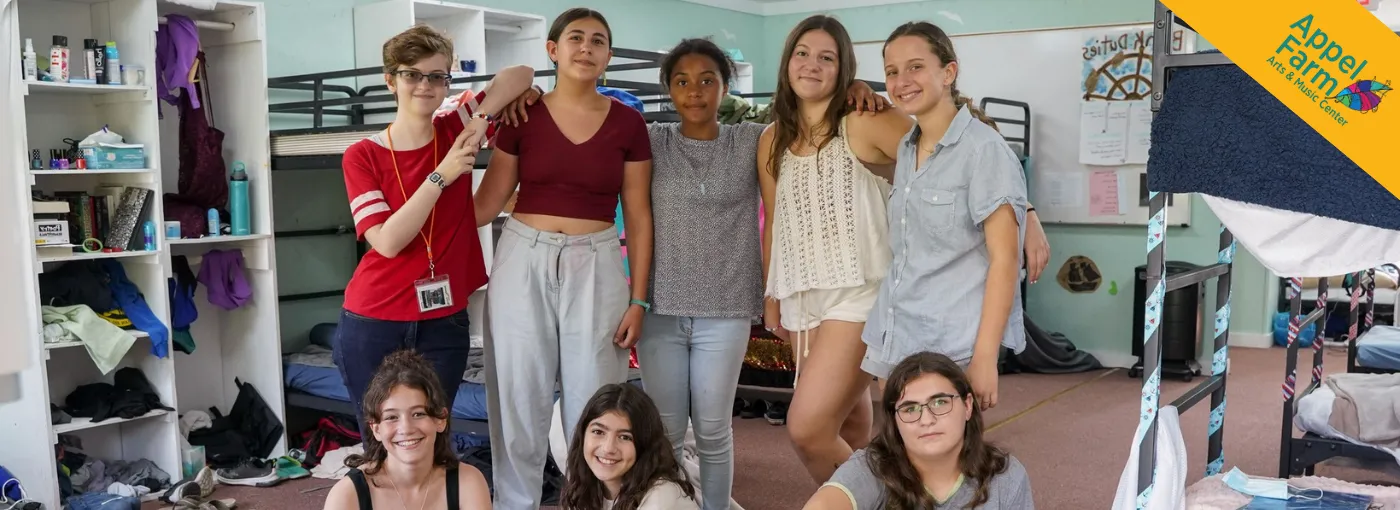
Some tried-and-true tips we always share with families are:
- Label everything, and then double-check it!
- Pack outfits rather than extra clothes. It helps campers get dressed faster and stay organized.
- Bring more socks than you think you need (somehow, they always disappear!).
- Choose clothes that can get messy and still be loved – paint, dirt, and creativity are part of the experience!
- Provide a laundry bag your camper can use from day one.
- Keep comfort items simple; one or two familiar things go a long way.
- Make sure your camper knows what is in their bag and where to find it!
- Test things before camp. Flashlights, cameras, and water bottles should all be ready to go.
- Leave space in the bag because campers often come home with projects, tie-dyed shirts, and new favorites.
Printable overnight summer camp packing checklist (PDF)
Ready to make packing simple? We’ve pulled everything together into one easy, caregiver-friendly checklist you can download and print!
Common camp packing-related questions
Even with a solid camp packing list, families usually have a few lingering questions. Below are some of the most common packing-related questions we hear at Appel Farm, along with clear, practical answers to help you feel more prepared.
Got more questions? Check out our FAQs page!
At Appel Farm, there is about 10 inches of storage under each bunk, so soft duffel bags are the best choice. They slide easily into that space, are lighter to carry, and are much easier for campers to manage on their own.
For campers staying for two or four weeks, laundry is done weekly under the supervision of the Camp Operations Coordinator. That means you don’t need to pack an entire month’s worth of clothing, but you should still send enough basics to get through about 10 days comfortably, especially underwear and socks.
Please avoid sending clothing that requires special care, since laundry staff will not check labels for washing instructions. And of course, make sure you label everything with your camper’s name!
Note: For campers exclusively taking dance classes, you can pack a small mesh laundry bag for dance outfits that need special laundering. These can be given to the dance staff once per week.
Label everything with the camper’s name! Use waterproof labels or a laundry-safe marker, and put your child’s name somewhere easy to see. A clear name label makes it much easier for lost items to find their way back – we recommend the collar or large clothing tags!
Yes, families traveling from farther away can ship luggage directly to Appel Farm before the session begins! This can make travel much easier, especially for campers flying or taking the bus.
If you would like luggage shipped from camp back home at the end of the session, you can arrange that through the Camp Office. Keep in mind that families are responsible for shipping costs.
All packages should be labeled clearly with your camper’s name and session and sent to:
Camper’s Name and Session
Appel Farm Arts Camp
457 Shirley Rd.
Elmer, NJ 08318 0888
Campers can pick up helpful everyday items and fun extras at the Appel Farm Canteen, our on-site camp store.
This includes:
- Batteries
- Earplugs
- Guitar picks
- Stationery
- Postcards
- Pens
- Stamps
- Deodorant
- Soap
- Menstrual products
- Toothpaste
- Combs
- Shampoo
- Conditioner
- Flashlights
- Textured hair care products, including gels and mousses
Kiddos can also purchase Appel Farm merch such as T-shirts, hats, and sweatpants, with options changing each summer – please check out the Caregiver Portal of the website for more up-to-date merch inventory!
Since campers do not keep cash or cards in the bunk, families add funds to a canteen account online before camp (recommended amount: 20 dollars per week).
Is Appel Farm Arts Camp a great first summer camp experience for kids?
For many families, the first camp experience sets the tone for how a child feels about overnight camp in general. Kids tend to do best in places where they feel welcomed and free to try new things without pressure, and this is where Appel Farm Arts Camp really shines! Our overnight summer arts camp is inclusive, neurodiverse, non-competitive, and rooted in creativity and community-building.
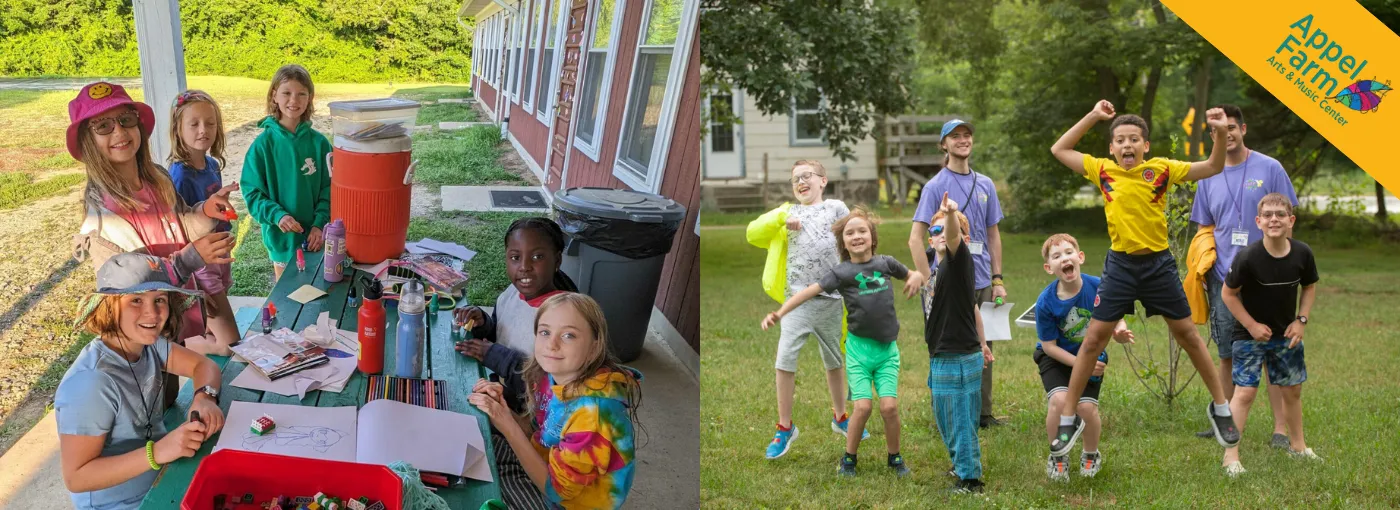
Just as importantly, the structure around camp life supports holistic growth, too. Small classes, experienced staff, healthcare support, and a campus culture centered on growth all help create a setting where kids can settle in and really have a memorable summer.
So if you’re looking for a place where your child can feel at home while exploring who they are and what they love, Appel Farm is a wonderful place to start!